Room guide
Before you buy more gear
Most of the disappointment in a home recording is the room arriving at the microphone a few milliseconds late. The three cheapest fixes are a furniture move, a rug, and two panels at the first reflection points. A new microphone comes after those, not before.
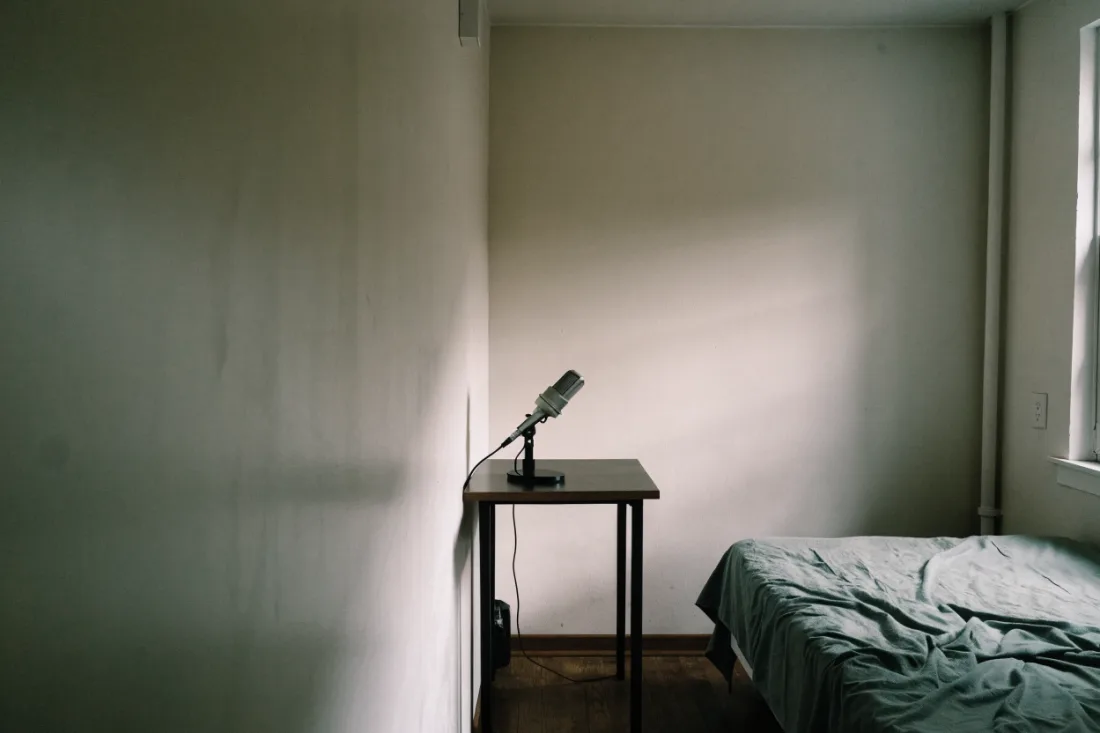
The three cheapest fixes
Pull the desk off the corner by about two feet. The corner is where bass piles up, and the microphone does not need to live inside that pile. Put a rug under the desk and the chair so the floor stops acting like a mirror. Then clap. If you hear a metallic flutter between the long walls, those walls need one panel each at the height of the microphone. That sequence costs less than a second condenser and it changes the take the microphone already owns.
The 9-point room check
This is the list Mara walks on a consult. Each point is either treatment, isolation, or a setup choice. Mixing them up is how people buy foam and stay disappointed.
-
Parallel walls
Clap between the long walls. A metallic zing is flutter echo: two bare surfaces tossing the sound back and forth. One panel on each wall, at microphone height, breaks that slap.
-
Corners
Low notes pile up where two walls meet the floor. That pile-up is a room mode, which is the reason a vocal booms on some notes and disappears on others. A corner bass trap gives the bass somewhere to go besides the microphone.
-
First reflections
These are the spots on the side walls and ceiling that bounce into the mic a few milliseconds after the direct voice. Panels there stop the boxy smear people blame on a cheap condenser.
-
Floor and ceiling
A bare floor and a low hard ceiling keep a vocal ringing after the note ends. A rug under the desk is the first floor move. A ceiling cloud comes later, once the walls are no longer naked.
-
Door and window gaps
A gap under the door leaks sound in and out. That problem is isolation, not treatment. Fabric panels will not seal a door, a window, or a garage bay.
-
Desk position
A desk shoved into a corner hears more boom than the same desk pulled two feet off the wall. Moving furniture is free and it belongs in the plan before any new interface.
-
Monitor triangle
The two speakers and your head should make a triangle, with the speakers aimed at your ears. Aiming them into a bare rear wall adds smear to every mix decision you make that night.
-
Noise floor
Computer fans, the HVAC register, and a refrigerator on the other side of the drywall set a floor the microphone will record. Write those down before you blame the preamp.
-
Headphones versus speakers
If a vocal only sounds wrong on speakers, the room is in the recording or in the playback. Headphones skip the room on playback. They do not fix the room the microphone already heard.
Treatment and isolation are different jobs
Treatment changes what the microphone and the speakers hear inside the room: reflections, boom, and smear. Isolation changes how much sound crosses a wall, a door, a window, or a floor. A fabric panel does the first job. It does not stop a garage door, a neighbor, or footsteps overhead. When the complaint is sound crossing into another room, the plan calls for mass, seals, and sometimes a second wall. When the complaint is a boxy vocal, the plan calls for absorption at the reflection points. The consult names which of those two you actually have.
Door seals and weatherstripping show up in the install scope because they are small isolation fixes. A framed inner wall, like the Marietta garage in June 2024, is quoted on its own line after the consult.
When the $180 plan is enough
A bedroom or a closet with intact drywall, a door that already closes, and a budget under $1,000 is often a DIY job. The $180 plan is a measured sheet: how many panels, how thick, which corners get a trap, and which purchases to skip. You build or buy the pieces yourself. We do not ship a kit and we do not take a cut from whoever sells you the fabric.
DIY is the wrong tool when the room is a garage or a basement with a leak you can hear from the next floor, or when you want the crew to hang the work and stand behind it for a year. That is the install, from $740 for a typical 10×12, or a full build from $2,150 with the gear blueprint included. The blueprint alone is $95.
Foam stuck in a checkerboard on one wall does not replace the nine points. Thin foam barely touches the voice band and it ignores the corners. If you already bought it, leave it up only where a clap still flutters, and spend the next dollars on traps and on the side walls.
Or run the three questions first. Open the Studio Budget Builder.